
What Carroll County Deed Records Document
Every deed that reaches the Carroll County deed records names the grantor, the grantee, and the land whose ownership is changing hands. What the document actually accomplishes, though, depends on its own wording. Reservations, exceptions, and the prior chain of title can all limit or shape the interest conveyed. Read the instrument itself, not just the index line.
The local Chancery Clerk's indexes cover deeds, deeds of trust, and substitutions of trustee. Other instrument types belong in the deed books, but the index may not list them by name. Confirm any additional deed type in the recorded books themselves.
| Deed Type | What It Does | Common Use |
|---|---|---|
| Warranty deed | Conveys the stated interest with deed covenants | Ordinary negotiated transfer |
| Quitclaim deed | Conveys whatever interest the grantor holds | Family transfer or interest cleanup |
| Trustee deed | Conveys under stated trust or sale authority | Trust or foreclosure context |
| Executor or administrator deed | Conveys through estate authority | Probate-related transfer |
| Tax deed | Records a tax-sale based conveyance | Delinquent-tax chain |
A recorded Carroll County deed does two things at once. It names the grantor and grantee. It also describes the interest being conveyed in a specific parcel of land. What that transfer actually accomplishes depends on the instrument's own language. It also depends on any reservations it contains and the prior chain of title. The Chancery Clerk's indexes list deeds, deeds of trust and substitutions among their entry types. For other deed varieties, confirm what the books actually contain. Do not assume a dropdown is complete.
The Carroll Chancery Index Is Not a Web Portal
The Land Title Association of Mississippi office listing shows General Index–Deeds, General Index–Deeds of Trust, General Index–Substitutions, a Sectional Index and a Map/Plat Book. Lis pendens and several lien and judgment categories round it out. Its "Land Records" line is blank. The listing publishes no online cutoff, result limit, document dropdown or export control. It offers no deed image or image charge. Those details only exist at the counter.
The first-district office sits at 600 Lexington Street #B in Carrollton. The second-district office works through P.O. Box 6 in Vaiden. First-district public hours run 8:30 a.m. to 4:30 p.m., Monday through Friday. Call the second district at 662-464-5476 and confirm hours before travel. A clerk terminal may expose indexes and book-and-page material that the public web does not.
Note: The index manifest comes from that Chancery Clerk listing.
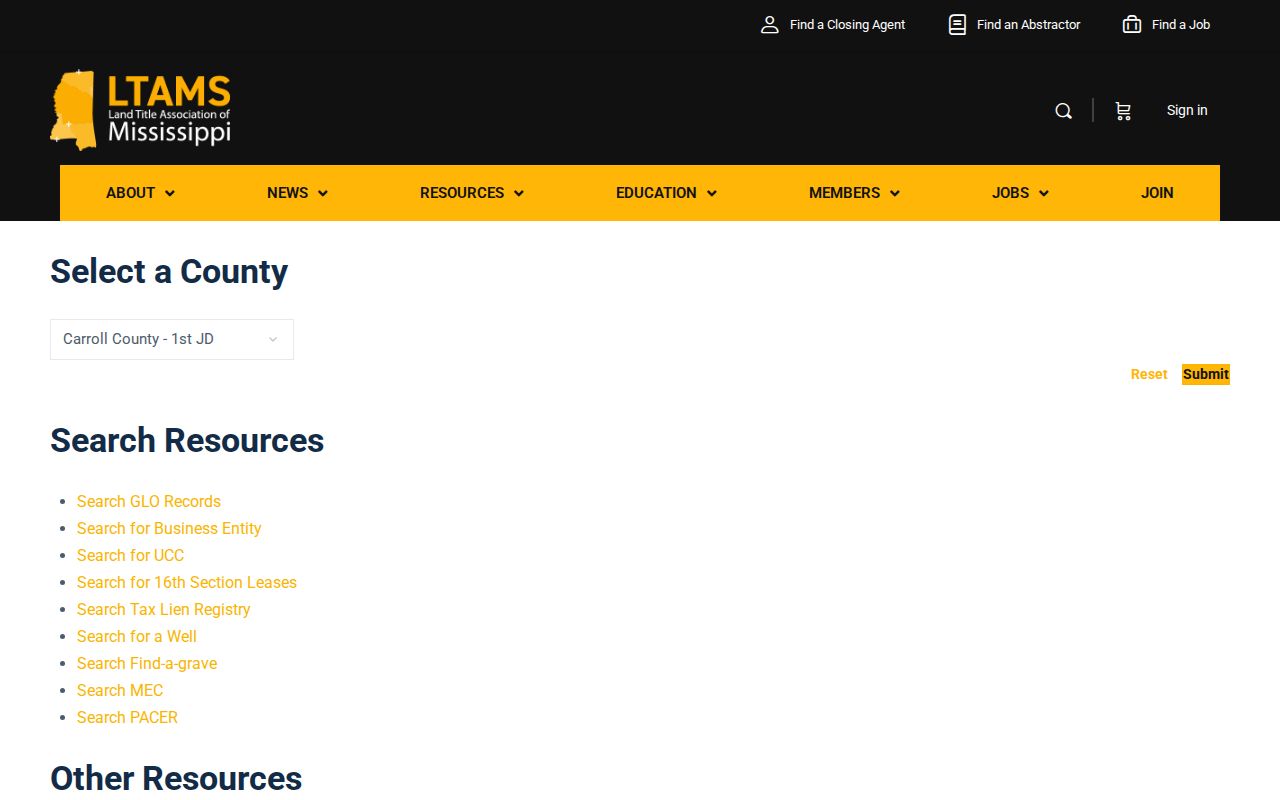
That list of distinct indexes shows why a deed-only name search cannot substitute for a broader review of recorded interests in Carroll County.
Direct, Reverse and Sectional Carroll Searches
Match the index to the question. A direct, or grantee, index finds when a named buyer received land. A reverse, or grantor, index finds when that person conveyed it. For rural tracts described by section, township, range, quarter section or government lot, the sectional index is the right tool. Town lots and subdivisions fit the Map/Plat Book instead.
| Search path | Input | Best result |
|---|---|---|
| Grantee | Buyer or receiving entity | Acquisition deed |
| Grantor | Seller or conveying entity | Later conveyance |
| Sectional | Section, township and range | Rural instrument lead |
| Plat | Subdivision, lot and block | Map/Plat Book reference |
| Known reference | Book/page or instrument number | Specific recorded document |
Watch spelling, initials, former names and entity variants. If an LLC appears abbreviated on the tax roll, compare the exact state business name. Trust and estate transfers may hide under trustee, executor, administrator or decedent in the deed records.
Walk the Carroll County Grantor-Grantee Chain
Start from the newest reliable deed reference, or ask the clerk for the present acquisition deed. Each instrument supplies the party name and land description needed to locate the prior link in the chain.
- Find the present owner's deed with that owner as grantee.
- Read the grantor, date, reference, legal description and reservations.
- Search that grantor as a grantee in an earlier period.
- Repeat while keeping district, tract description and name variants aligned.
- Move into deed books, abstract microfilm and archives when the modern index ends.
- Grantor
- The party conveying the stated interest.
- Grantee
- The party receiving that interest.
- Chain of title
- The linked sequence of conveyances for the same land.
- Book/page or instrument number
- The clerk's locator for a recorded document.
Two Districts Can Split a Carroll County Deed Trail
Carrollton is the first judicial district seat. Vaiden is the second. That geography affects both current requests and historical holdings. A Carroll County search limited to one courthouse can look complete while missing an index or abstract run held at the other district. Postal city settles nothing, especially for rural delivery routes.
Give the clerk the situs and the parcel number. Include the TAXMAP, legal description, and any section-township-range or plat reference. Ask which district controls the tract. Note the answer in your chain log. When a description crosses an old parent tract, inspect both the predecessor parcel and the recorded plat.
Note: Keep each deed's district beside its date and book reference so two similarly named owners are not joined by mistake.
Carroll Deed Books Reach Beyond Modern Indexing
The historical access chain here is unusually specific. FamilySearch catalog references identify First District deeds from 1800 through 1938. Second District records run from 1867 through 1900. A General Index covers 1874–1892. The MDAH microfilm catalog lists abstract books from 1838 through 1978 across several reels. Abstract books are research aids, though, and may not hold complete deed images.
MDAH Series 2050 includes an 1839 indenture and deed finding-aid entry involving M. and L. Gary and A. Gary, along with historic tax-sale and redemption items. Seeking a scan or Media Room access? Cite the record series, box, reel, volume, district, year and exact item wording. Verify any abstract or archive description against the original deed when the chain matters.
The first Carrollton courthouse burned. The current 1876 courthouse houses the county records. That history is not proof that any specific deed is missing. But it explains why a broken historical chain calls for parallel tax, probate, plat and archive sources in Carroll County.
Fraud Alerts Are Notice Tools, Not Deed Proof
Local news has promoted a free Carroll County property-fraud alert. The general iCounty notification form asks only for county and email. Carroll County participation and the clerk-approved signup route remain unclear. Call the Chancery Clerk before enrolling.
These services alert a subscriber after a matching document is recorded. They do not block recording. They do not restore title, verify signatures or replace review of the actual instrument. Preserve the alert, the recording reference and the date. Then contact the Chancery Clerk about any suspicious filing.
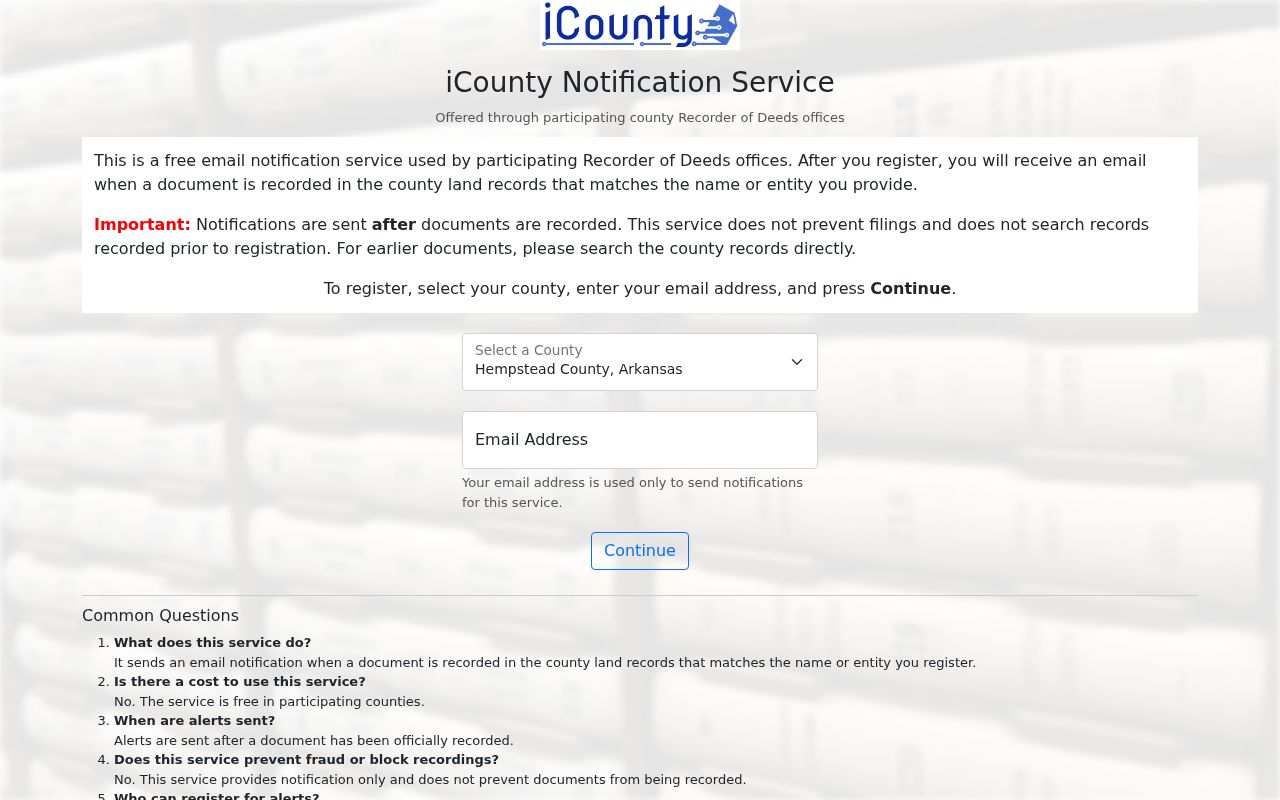
The county dropdown and email flow illustrate the notification model, but confirming with the Carroll clerk remains essential before relying on an alert.
Request a Carroll County Deed Copy
With the reference in hand, tell the office exactly what you want. Options include inspection, a plain paper copy, an electronic scan, a certified copy, or research help. Give the district, the book and page or instrument number, grantor, grantee, approximate date, and the parcel and legal description. Carroll County posts no current copy or certification fee schedule. Ask for a price quote before any work starts.
You can work at the counter or a local terminal where one is available, call the first district at 662-237-9274 or the second at 662-464-5476, or mail the proper office. For an identifiable nonexempt record not otherwise available, a written request under the Mississippi Public Records Act can seek an electronic copy at actual cost. Remember that an archive scan and a certified county copy are different products with different weight.
Recorded, not guaranteed. Carroll County deed records show filed instruments, not a title opinion. Unrecorded interests, indexing errors and later releases can require professional title review.
A Carroll Deed Reference Is Only the Locator
The GIS fields DEEDREF and DEEDDATE can speed up a Carroll County property search. Neither field is the deed image itself. The public parcel schema exposes no attachment and no verified sale-price field. Treat the reference as a locator only. Then pull the instrument and read it closely: grantor, grantee, legal description, consideration language, execution and recording dates, reservations, easements, and acknowledgments.
When the reference fails, search by both parties and the tract description. A null field may simply mean the parcel data never carried the value. It does not mean no deed exists. Keep the parcel card as a lead. The clerk's index and book should control the document search every time.
Check Carroll Deeds Against Plats, Liens and Probate
A deed chain can look unbroken and still miss a record that changes everything. Compare each legal description against PLATREF, PLATDATE, TAXMAP, and the Map/Plat Book. A replat, vacation, split, or combination can matter a great deal. It may leave an older instrument tied to a parent description. Rural acreage often needs section, township, and range rather than a street address.
Carry deeds of trust forward through assignments, substitutions, modifications, partial releases, and satisfactions. Check lis pendens, construction liens, federal tax liens, and judgment indexes. Search them under both people and entities. A transfer after death may be explained in the Will Book or the Chancery docket. There an executor, administrator, heir, or partition deed breaks a simple buyer-seller sequence. A foreclosure notice is a lead, not the final conveyance. Carroll notices go up on the Chancery Clerk hallway wall. Sales are held at the west front door of 600-B Lexington Street. Legal publication runs in The Conservative. Match any notice to the later recorded trustee deed, release, or court result. Add it to the chain only after that match.
For a historic mismatch, set the deed description beside old tax assessments. Set it beside the city-map series as well. Names, roads, and parcel identifiers shift over time. The land itself usually stays traceable through the sectional index and neighboring tracts.
Note: Write down the district and index you searched, since a no-result from one Carroll County desk does not rule out an instrument at the other district.