
Four Numbers Behind a Carroll County Property Value
The Carroll County Parcel Viewer and the state cadastral layer both carry value fields. Labels matter. So do tax years, since the Assessor/Collector develops the assessment record and the Tax Collector bills from the adopted roll.
| Value | What It Is | Where |
|---|---|---|
| True value | Appraisal basis before the statutory ratio | Assessment framework |
| Assessed value | True value multiplied by the applicable class ratio | Assessment roll |
| Land and improvements | Separate `LANDVAL`, `IMPVAL1` and `IMPVAL2` components | Parcel data |
| Sale consideration | An amount or recital in a transfer, when stated | Recorded deed |
Class I means owner-occupied single-family. Class II covers other real property. Mississippi applies 10 percent of true value to the first and 15 percent to the second, while classification, homestead treatment and millage shape the final tax outcome without turning the assessment into a predicted selling price.
LANDVAL, Improvements and TOTVAL in Carroll County
The state cadastral schema publishes `LANDVAL`, `TOTVAL` and `TAXYEAR`. Improvement values ride alongside parcel identifiers, situs, owner, deed reference and legal description. Treat `TOTVAL` as the dataset's reported total for its year. It is not a sale appraisal. Copy `PARNO`, `CAMA` and `PPIN` when present, plus `TAXMAP`, `TAXYEAR` and `DEEDREF`, with every value.
The county's dynamic tax and property application is the public starting point. It supports a parcel-specific value check.
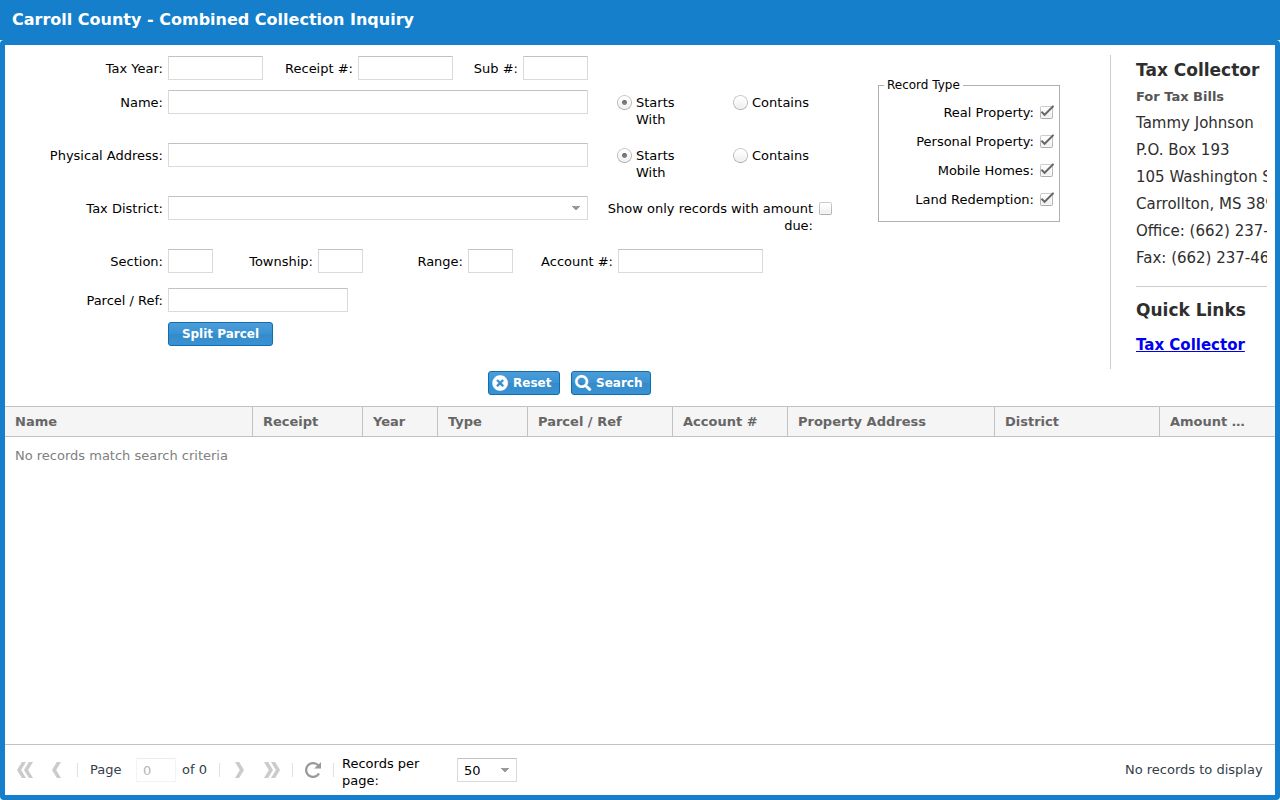
The county route runs through the official tax and property application. Its JavaScript form may not load for every visitor. If the controls stay blank, keep the address, parcel number and tax year together. Then call the Assessor/Collector at either county office. Ask which field represents land and which represent improvements. Also ask whether the displayed total belongs to the current adopted roll.
Some aliases arrive blank because the originating county data omits fields. A blank value is a reason to call. It is not proof the land or improvement has no worth. Compare parcels by collecting the same fields for the same tax year. A larger `TOTVAL` can reflect more land. It can also show a different class, added improvements, or a roll update. It does not prove a higher open-market sale. `DEEDDATE` can locate a transfer period. The schema exposes no sale-price field. The recorded deed must be checked when consideration matters. Even that recital may be nominal or qualified.
Note: A deed date is a transfer clue, not a price field.
Mississippi Ratios Shape Carroll County Assessments
The Department of Revenue appraisal guidance describes five classes and the county board's role in Carroll County assessments. Read the classification on the parcel record. Never infer it from appearance. The sequence runs from true value through the statutory ratio to assessed value, and millage enters later in the tax calculation.
Homestead is a filing, not just an address. State guidance sets a January 1 through April 1 window with ownership and occupancy conditions. Two similar houses can land in different places. Their classifications or exemptions may differ, changing the taxable effect even within the same county.
Look Up a Carroll County Property Value by Parcel
The county tax/property application depends on JavaScript. If it will not load, fall back on the parcel viewer and county office channels rather than guessing at a Carroll County value.
- Locate the address and confirm its situs and legal description.
- Save parcel IDs, land value, improvements, total and tax year.
- Confirm classification, homestead and roll details with the Assessor/Collector.
- Use `DEEDREF` to request the deed when transaction consideration matters.
- True value
- The appraisal basis before the class ratio.
- Assessed value
- The value after the class ratio.
- Millage
- A rate used with assessed value in calculating tax.
- Consideration
- The transfer amount or recital in a deed, sometimes nominal or qualified.
January 1 Can Explain a Value Record Mismatch
A value record can show a name that looks wrong at first glance. The Carroll County Tax Collector lists each January 1 owner on that year's tax statement, so a sale closed later in the year leaves the old name of record on the bill even after the new deed is recorded. That gap is normal. It just reflects the assessment calendar. Match every dollar figure to its own year. Never pair a recent transfer price with an assessment cycle that closed before the sale, because the two numbers describe different moments in the parcel's history.
For a recent change in ownership, then, a current deed offers the stronger lead, while the assessor record stays the authority on the county's value components and land classification.
Challenge a Carroll County Assessment on Time
The state property-tax guidance explains appeal rights. The first Monday in August marks a key deadline. Confirm the local calendar for the current year anyway. Come with the parcel number, tax year, class, homestead status, land and improvement components, and any evidence supporting a correction.
Deadline check. Confirm the hearing and filing date directly with the Carroll County Assessor/Collector before relying on general August timing.
Send Each Carroll County Value Question to Its Keeper
The Assessor/Collector handles appraisal and roll information at 105A East Washington Street in Carrollton, 662-237-9217, and 803 Front Street in Vaiden, 662-464-8852. Billing and delinquency questions go to the Tax Collector. The Chancery Clerk supplies a recorded deed when consideration matters.
Ask for prior assessment cards when comparing years. Find out what drove a change: reappraisal, construction, demolition, classification, correction, or a parcel split or merge. That keeps assessed value, bill balance and sale consideration apart. Each office answers one question well.
Note: Always include the parcel number and tax year in an office request.
What Carroll County Assessed Value Does Not Prove
An assessment supports the public tax system. That is its whole job. It does not promise a selling price, establish building condition, or prove title, and it cannot replace an appraisal prepared for a specific date and purpose. A landmark's cultural weight likewise proves no preservation easement, exemption or price premium.
Value versus price. A Carroll County assessed value is not a prediction of what the property will sell for. Use an appropriately qualified appraisal when a transaction requires a current market opinion.
A Carroll County property value record answers narrow questions. Compare public figures only after you control for the tax year, classification, and any parcel change. The stated consideration in a deed can help, but an instrument may omit or qualify it. These limits are not flaws. They simply mean each record was built for one job. It does that job well when you respect it.
Start a multi-year comparison with one parcel and one field set. For each tax year, note the land value, every improvement value, the total, the class, homestead treatment, and the acreage. Log any split or merge along the way. When the public app hides prior years, ask the Assessor for older cards or rolls. A sudden jump may trace to construction, demolition, a reappraisal, a correction, or a redrawn parcel. That is often the cause rather than a real shift in the market.
Classification matters more in Mississippi than most buyers expect. Class I generally carries a 10 percent assessment ratio for owner-occupied single-family property. Class II generally carries 15 percent for other real property. Never assign a class from a house's look or a mailing address. Read the roll entry itself and check whether homestead was filed in the January 1 through April 1 window. Two tracts with similar true values can still land far apart on the tax bill.
Sale price lives on a different trail. Use DEEDREF to request the instrument from the Chancery Clerk. Then read the consideration language, execution date, parties, and legal description. The cadastral schema exposes DEEDDATE but no verified sale-price field. Treat a nominal recital, family transfer, estate deed, or partial-interest conveyance with care. None of them is an open-market comparable.
Geography can be tricky here. Carroll County runs two assessor offices. The Carrollton office serves as the first-district center, and the Vaiden office is a second local route. A postal city decides nothing about district, class, or city limits. Bring the parcel number, situs, tax map, and legal description. That way staff can find the right roll without guessing from a ZIP code.
Label every figure you collect. Keep the parcel number, value type, class, tax year, source date, and office response together in one place. Without those labels, a true value, an assessed value, a tax bill, and a deed recital start to look interchangeable. They are not.